Panel Discussion
Artificial Intelligence is Powerful, But It Must Be Responsible
In today’s fast-changing world, AI is not just a tool — it’s a co-worker, a decision-support system, and a strategic enabler. But with great power comes great responsibility. AI must be fair, transparent, and ethical.
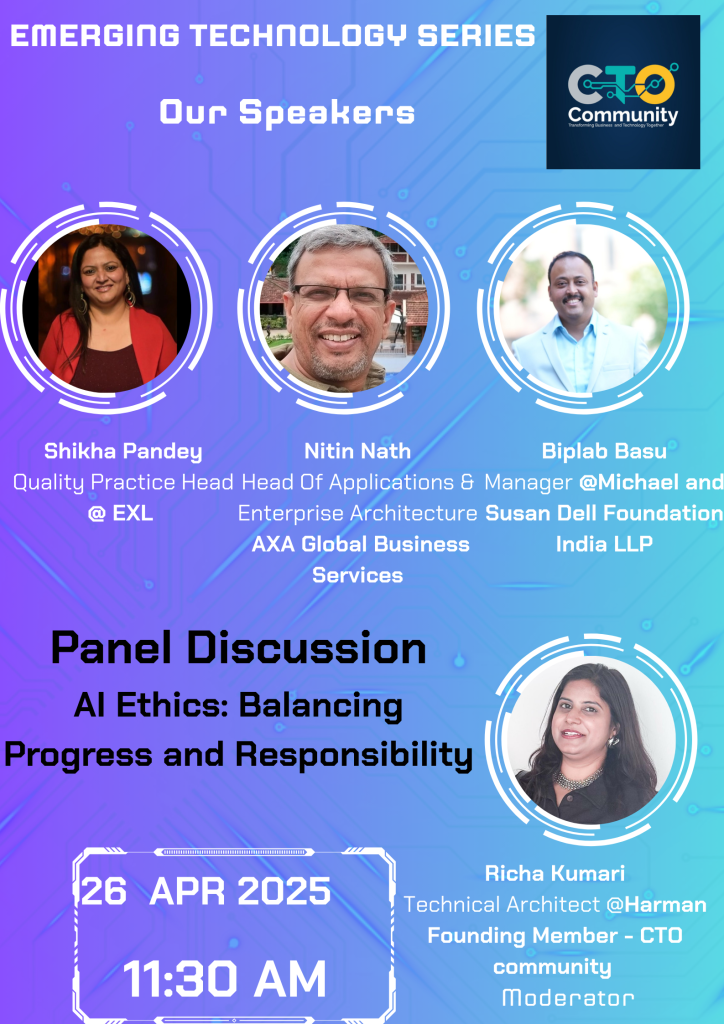
To unpack this critical theme, CTO Community India hosted a thought-provoking panel discussion on Responsible AI, moderated by Richa Kumari (Technical Architect – Harman & Founding Member, CTO Community India).
Our distinguished panelists brought diverse expertise from different industries:
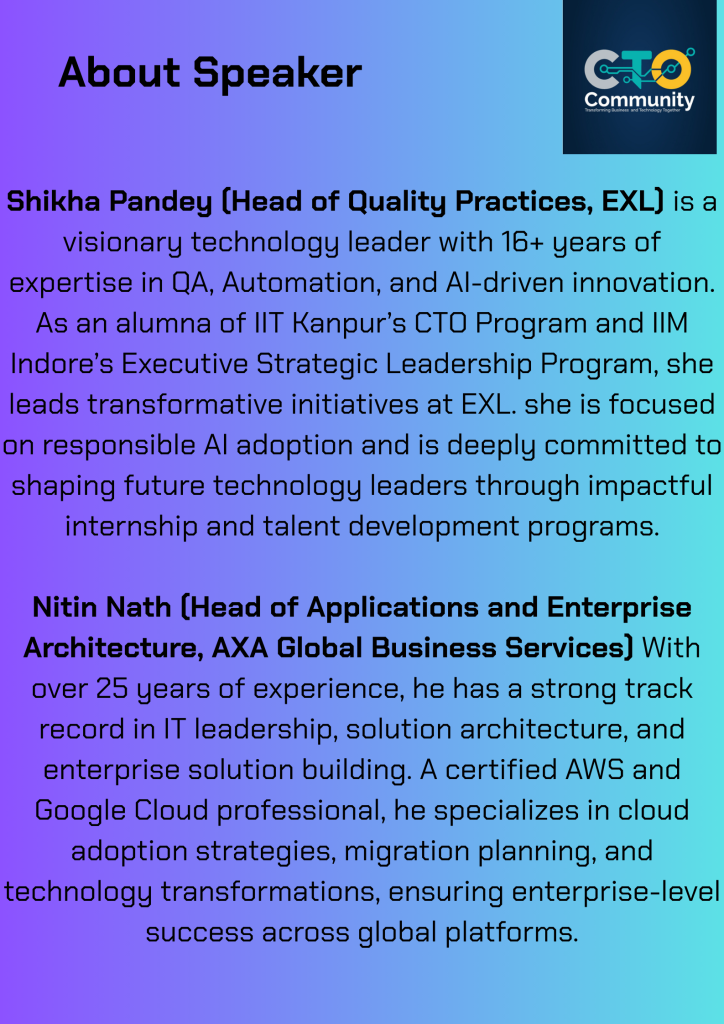
- Shikha Pandey (Head of Quality Practices, EXL)
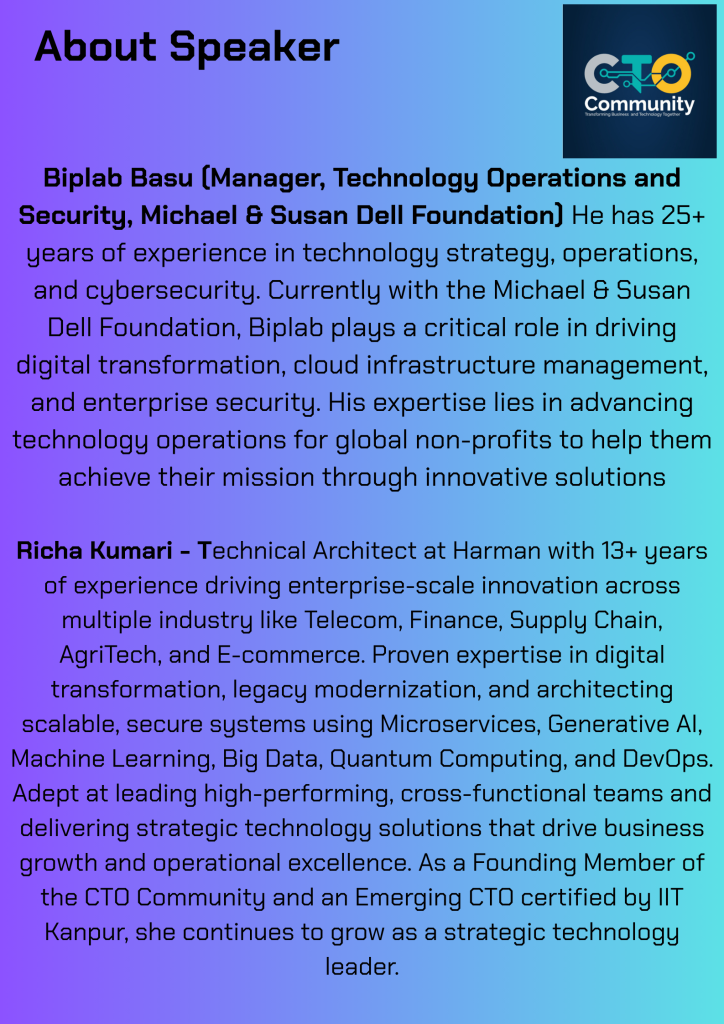
- Biplab Basu (Manager, Technology Operations and Security, Michael & Susan Dell Foundation)
- Nitin Nath (Head of Applications and Enterprise Architecture, AXA Global Business Services)
The discussion was rich with real-world insights, leadership lessons, and practical examples.
🔑 Key Leadership Lessons from the Panel
1. Keep Humans at the Center
Leadership Thought: AI should assist human decisions, not replace them.
Example: Blind reliance on AI (like blindly following navigation apps) can cause critical mistakes. AI should support human judgment, not overrule it.
2. Build AI with Transparency
Leadership Thought: Customers trust businesses that explain how their AI works.
Example: When companies can’t explain why AI makes certain decisions, trust erodes. Transparency must be designed in — not bolted on.
3. Actively Fight Bias from Day One
Leadership Thought: Diverse data leads to fairer AI outcomes.
Example: Training datasets must represent all groups across cultures, regions, and experiences. Even synthetic data can help uncover hidden biases.
4. Diverse Teams Build Better AI
Leadership Thought: Diverse developers and testers catch blind spots early.
Example: Cross-functional collaboration (developers, regulators, policymakers, end users) ensures AI reflects real-world complexity.
5. Don’t Blindly Trust AI
Leadership Thought: AI is an assistant, not the boss.
Example: In some organizations, AI-generated content became repetitive or inaccurate because humans stopped reviewing outputs. Human oversight remains critical.
6. Ethics is Everyone’s Job
Leadership Thought: Ethics must be part of daily decisions, not a compliance checkbox.
Example: Even small startups can bake ethics into their team culture — not delegate it to a separate committee.
7. Innovation Must Have Guardrails
Leadership Thought: Move fast, but audit regularly.
Example: Adding small governance checks during development ensures responsible innovation, rather than fixing issues post-deployment.
8. Protect Human Values: Dignity, Privacy, Emotions
Leadership Thought: AI must not strip away human emotions and dreams.
Example: While AI boosts efficiency, leaders must safeguard human dignity, privacy, and emotional connection.
Closing Reflections from the Panel
✔ “The real success of AI is not how smart it gets, but how responsibly we use it.”
✔ “Building ethical AI is not an add-on — it’s a foundation.”
About Speakers