Building the Next Generation of Digital Co-Workers
The 3rd event of our Gen AI Series explored the fascinating world of Agentic AI – where AI agents are no longer limited to answering questions but can plan, act, collaborate, and remember like true digital teammates.
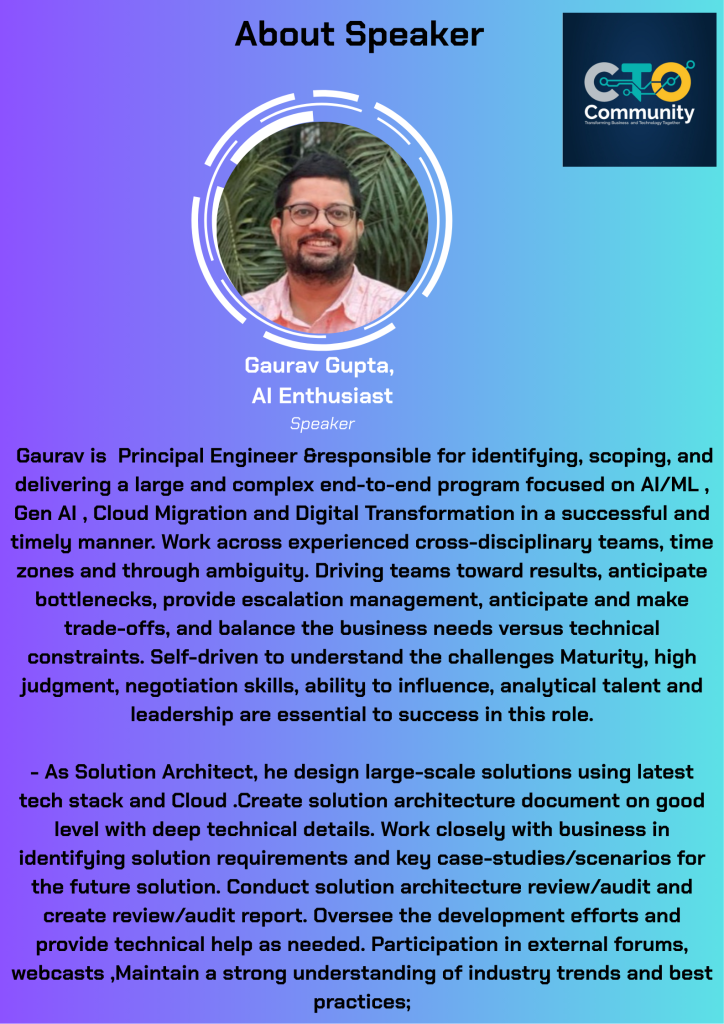
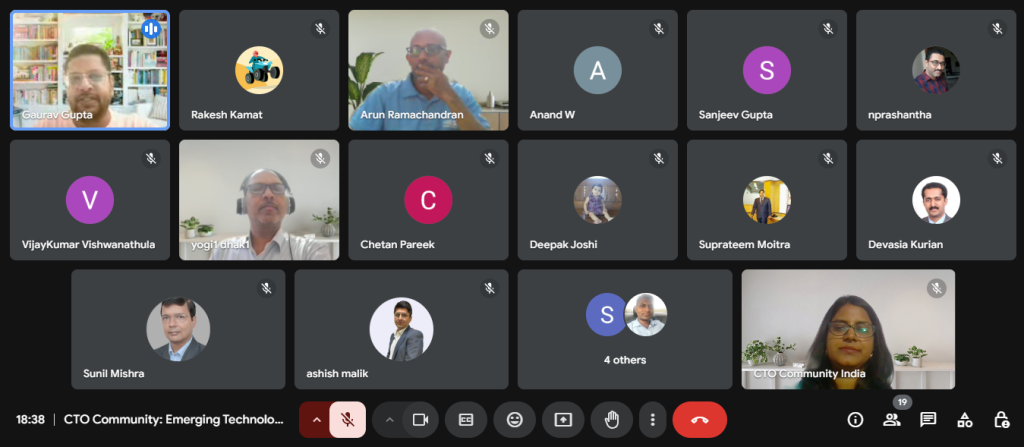
This session was led by Gaurav Gupta, an expert in AI agent design and LLM engineering, and hosted by the CTO Community, a collaborative platform that connects technologists, architects, and leaders across industries.
Recap: Where We Started
Part 1 – Setting the Foundation
We began with the basics of AI & Gen AI, covering:
- What is AI and Generative AI?
- How models like GPT work
- Traditional AI vs. Generative AI
Part 2 – Retrieval Augmented Generation (RAG)
We then deep-dived into RAG, an approach that grounds LLMs with contextual, real-time data.
🧩 Highlights included:
- RAG architecture & prompt templates
- Graph RAG for structured knowledge
- Multimodal RAG (text, images, audio)
- Enterprise chatbot use cases
- Prompt engineering best practices
Part 3 – Agentic AI, Agent Architecture & Frameworks
Agent Architecture, Simplified
Agentic AI models operate in a 4-step human-like problem-solving loop:
- Plan the goal
- Use tools/APIs to execute
- Make decisions with data
- Retain memory for future refinement
This makes agents proactive, not just reactive.
Frameworks That Power Agentic AI
We explored developer-friendly frameworks:
- LangChain – Orchestration & tool routing
- Crew.ai / Agent.ai – Role-based agent assignment
- LangGraph – Dynamic state transitions
💡 These frameworks make it possible to spin up agents quickly while maintaining flexibility.
Real-Time Demo: “Movie Buff” Agent
Using Crew.ai, we built a Movie Buff Agent capable of chatting endlessly about films and recommending your next binge.
This fun demo illustrated how to:
- Define personas
- Assign goals
- Launch agents with minimal code
Multi-Agent Systems
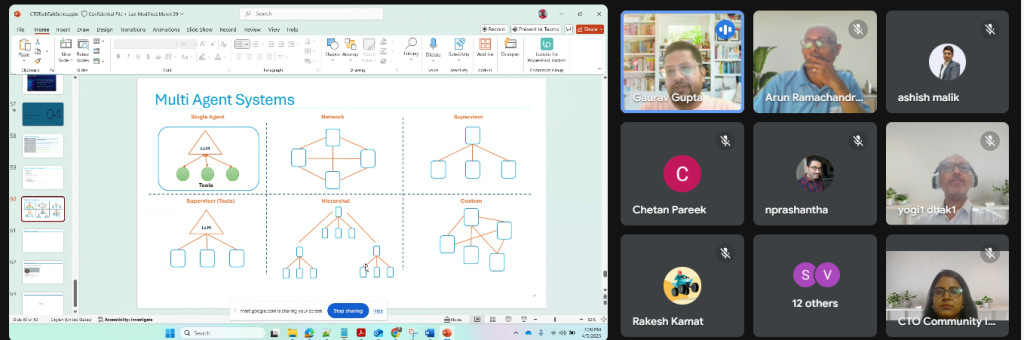
Inspired by real-world teams, agents can collaborate in specialized roles:
- Planner – designs task flow
- Critic – evaluates responses
- Reflector – iterates & optimizes
These systems enable networked or hierarchical collaboration, powered by LangChain integrations.
RAG + Agents = Smarter LLMs
By combining RAG with Agentic AI, we explored:
- Standard RAG
- Graph RAG – relationship-driven
- Multimodal RAG – documents + images + voice
Tech + Leadership Insights
⚖️ Can AI Agents Replace Jobs?
- Poll results leaned “yes,” but the shared perspective was clear:
👉 Agents augment, not replace, human creativity and decision-making.
💡 Productizing Agents
- From internal task bots to customer copilots, agent-based products are rising.
- Tools like AWS Bedrock, LangSmith, and open-source LLMs were discussed.
⚙️ Framework vs. Native Code
- Frameworks = speed & simplicity
- Native Python = control, optimization, performance
🔍 Observability & Debugging
- Enterprises need transparency in agent behavior.
- Tools like LangSmith and AWS Bedrock support debugging and monitoring.
🏢 Enterprise Use Cases
- Workflow automation
- Customer support copilots
- Financial/marketing agents
- Knowledge management systems
🛡️ Governance & Security
Key leadership concerns:
- Prompt injection
- Memory abuse
- Model security & access control
🔑 Security must evolve as fast as AI itself.
📅 What’s Next?
Stay tuned for our upcoming panel discussion organized by CTO Community
“AI in Action – Insights from Industry Leaders & Architects”
where CTOs and architects will share real-world AI adoption stories.